Raw materials, parts and finished product traceability practices have traditionally been the province of highly regulated operations that are legally bound to demonstrate compliance, such as the pharmaceuticals, aerospace and automotive sectors. Now, as a much wider industrial base wakes up to the promise of Industry 4.0 and its impact on manufacturing economics and logistics, traceability issues have taken on much greater significance for companies operating at every stage along the supply chain.
Traceability has always been a vital aspect of pharmaceuticals production and the supply of military, aerospace and automotive components which carry real risk of harm to end users - not to mention supplier reputation - should a product have been compromised during the manufacturing process. However, Industry 4.0 sets a higher priority for traceability among more mainstream manufacturers; efficient production methodologies demand an unbroken, fully connected supply chain along which participants are able to track not just the movement of parts and materials in real time, but the history of their manufacture, the processes involved and the sources of the raw materials used in that manufacture.
With the evolution of Industry 4.0 and its requirements for the efficient collection and dissemination of manufacturing data, traceability is becoming an essential element of the manufacturing process, no matter at which level it happens to be deployed within the supply chain.
Tracking individual parts throughout the entire supply chain’s manufacturing processes and beyond into distribution and the after-market are critical to the functioning of highly-automated ‘smart’ factories, cyber-physical production systems and interconnected supply chains that define the Industry 4.0 manufacturing operation.
Pryor will be showcasing traceability and data capture software and connected technologies; demonstrating the ability to track individual parts throughout the entire manufacturing process, demanded by Industry 4.0.
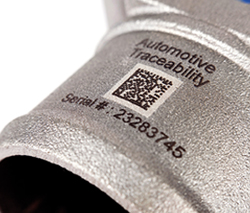
Laser marking will also be on display, with high speed “on-the-fly” marking performed on parts on a moving conveyor. Used in high volume automotive production, each part can be uniquely identified, logged and traced within 0.5 seconds.