“We don’t believe it!” – that’s how experienced machinists reacted to an encounter with a machine tool that produced nine bores per part with only 0.000020”
(0.5 µm) variation, all day long, with essentially no operator attention.
That is a 2.21 Cpk process capability. It’s game changing technology in a shop like Waltz Brothers Inc.,
a precision grinding and machining operation where flight-critical hydraulic pumps are produced by the hundreds every year. “When I showed this new machine to a customer for whom we’d been making these parts, they were so impressed they wanted us to commit to a blanket order for all their parts for the next five years,” said company president Larry Waltz.
One of the keys is a patented new smart tooling technology that servocontrols the force on a honing machine’s tool feed system.
Machine parts like you’d have to grind them
“We’re a second generation grinding business,” explained Mr. Waltz. “Our focus is close-tolerance precision parts. Piston pumps are a good niche for us, and the most critical parts we make.”
The heart of the pump, called a cylinder block or rotor, starts as a turned blank up to eight inches diameter. Nine circumferential piston bores from 0.1875” to 1.5” (4.8 - 38.1 mm) diameter are roughed in on a machining center, and the part may be heat treated. The piston bores are not through holes.
“Nine bores are common to most all pump designs,” Waltz explained. “The pistons have a total diameter tolerance of 0.000120” (0.003048 mm), while the bore ID’s on the cylinder block have a total diameter tolerance of 0.000240” (0.006096 mm). We must also maintain tolerances of 0.000020” (0.5 µm)) for bore roundness, 0.000040” (1 µm) straightness, 4-8 µin (0.1 - 0.25 µm) Ra bore finish, and less than 3 µin (0.07 µm) surface on the pistons. We have three Zeiss CMM’s that can scan the piston bores at various levels for cylindricity. All these parts are serialized, traceable to the material and processes used to create them.
Hone, measure, repeat...a lot
Waltz had been using standard horizontal honing technology from Sunnen that requires a degree of operator skill. “Honing and inspection could easily take two hours per part. Our challenge to Sunnen was to automate everything, including part indexing, air gaging, and recording of gage readings for the part’s history.”
What is multi-feed honing?
The new patented multi-feed honing capability gives users a choice of tool-feed modes to achieve the shortest cycle times, lowest part cost, and longest abrasive life. The two different modes allow the user to select the better option to suit the workpiece geometry, material and tool type/size. “In effect, the machine adapts the tool to what is happening in the bore when the abrasive contacts it,” Waltz said. “This is an advantage when we are honing rotors with sleeved bores, because the liner sometimes has a little memory and can spring back. The new machine recognizes these variations, adapts, and produces bores with exceptionally consistent size control.”
Smarter honing
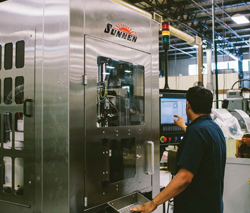
Waltz’s new SV-1015 vertical CNC honing machine has a single 5-hp AC spindle with 10-hp servo stroking system and X-Y air bearing table. The operator loads the workpiece in a dedicated fixture. After each bore, the table indexes 90 degrees to an Etamic air gaging station where the necessary readings are taken and stored. If the bore passes inspection, the table moves the part to a robot that indexes it for the next bore, duplicating this routine eight times to complete a part.
“On a recent project with an allowable bore tolerance of 0.000240” (0.006 mm), we easily held a tolerance range of 0.000060” (0.001524 mm) – and we tripled the previous production rate, while reducing the labor component by 80 percent,” said Waltz. “Our CMM measurements correlate well. The process capability and data reporting features in the machine have been a great advantage to us and our customers.”
Sunnen Products Limited
+44 (0)1442 393939
www.sunnen.co.uk