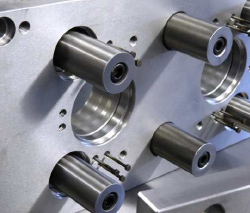
A family-owned business, Pentagon Plastics was established in 1972 to provide a low volume plastic component moulding service to customers in various industrial sectors. Today, with an extensive toolroom and an impressive range of plastic injection moulding machines, the company provides a one stop shop for customers. Working in partnership, Hasco has become the company’s preferred mould tool component supplier.
A technical moulded component supplier with 33 experienced staff, Pentagon Plastics supports customers in a variety of high tech industries, including medical components, security, aerospace, automotive, furniture and marine in a whole spectrum of filled and unfilled materials, such as polypropylene, PEEK, Torlon, Polycarbonate, ABS, Nylon 6 and Nylon 11.
Average batch size tends to be between 2,500 and 5,000, but highly engineered niche aerospace parts might only require low single numbers. At the other end of the scale the largest batch size run is about 100,000. For larger customers the company supply’s up to 50 products on a Kanban supply system with production operating to pre-agreed stock levels.
Set up by the father of managing director, Paul Edwards, the Horsham-based company was originally called Small Batch Plastics, and the name reflected the company’s activities at that time. “Back then,” recalls Paul Edwards, “all the tooling was quite basic and geared to low volume, but during the early 1980s we expanded our toolroom to increase the size and complexity of the tools that could be produced.”
{gallery}hasco-mar-10-15-1{/gallery}
Since then the toolroom has had the capability to produce tools that can be moulded on a 280 tonne press. Having the toolroom under the same roof as the moulding shop maintains both quality and flexibility, as Paul Edwards points out: “Everything we do is bespoke to the customer. We are exceptionally good at taking the customers’ products, offering design assistance at the early stage, using our 3D printer for rapid prototyping if it is required, and working with the customer to develop the best product.
“By making some adjustments on the CAD model such as draft angles and potential split lines of the mould we take cost out of the tooling where we can. The largest cost to the customer is the mould tool at the outset of the project, once we start moulding repeat production the cost per component is relatively small. So, if we can make some recommendations at the early stage of the product to reduce the initial cost of the mould tool it is more likely the products are going to make it to market in the first place.”
Quoting a mould tool for a new product is made more difficult because the exact volumes are unknown – predicted, but unknown. “Sometimes the customer will ask for a price range of say between 100 and 100,000 parts. Of course, the expected volumes make a big difference to the format of the tool, its configuration and the amount of cavities required. For example, if the total required is just 5,000 we would suggest a single impression mould as the scale of production would not make it worth investing in multi-cavity tooling. A single cavity may cost around £6,000 while an eight impression tool would be closer to £25,000 so you suddenly have a big investment at the outset. It also determines the size of injection moulding machine that will be needed.
Pentagon Plastics will always progress the project with its chosen mould systems partner Hasco. “We design the mould tool and liaise with Hasco for the plate sizes and any mechanisms needed. It is fair to say we get Hasco involved at a very early stage, sometimes at the point of quoting. There may be a Hasco system available that would improve the tool; we supply the drawings to Hasco to get the best advice that can also assist us with a competitive quotation when a greater technical input is required”
Although the relationship between the two companies goes back over two decades it has become much stronger during the past five years with Hasco becoming the preferred supplier. Pentagon Plastics used to move its mould component business between three suppliers to keep it competitive, but one was standing above the others time after time so it became better for the business to single source from Hasco.
“We are very loyal to our suppliers and I do not believe in chopping and changing to try and save a little bit here and a little bit there because you cannot build relationships that way. It is much better to work with someone you know you can work with creating a partnership. We look to work with people who can talk to you honestly and openly, it means if there is an issue it can be discussed to find a solution that works for everyone.
Mould tool products supplied by Hasco include standard plates, pins, sleeves and so on. Pentagon Plastics is also looking at the DLC (Diamond Like Carbon) coated product range offered by Hasco. The company’s growing reputation in the medical sector requires a ‘clean’ mould tool, with minimal or even no grease.. The self-lubricating nature of Hasco DLC coated products, which include ejector sleeves and pins, latch locking devices and location elements help to achieve this goal.
Paul Edwards says: “For every customer we focus on what is required; how to make the tool and its longevity. Often a designer looks at tooling from a cost orientation, maybe using P20 steel rather than fully hardened for certain parts and making everything solid rather than putting inserts in. We never approach it from ‘this is the cheapest you can get a tool’ we always say ‘this is the optimum tool for your needs’. Hasco help us achieve this because in fairness we do not know the whole product range available. Until you meet a certain type of requirement you are unaware that there may be a better way to make it, using latch-lock mechanisms and pre-engineered parts for example”
Most of the tools produced by Pentagon Plastics remain with the company to be stored, serviced with a routine maintenance plan that is part of the component price, and put into production as required by the customer.
The company is investing further in its facilities and processes with the toolroom being expanded to take on larger suites of tools, and is looking to take on apprentices in the near future. “We are still one of the few companies that operate a toolroom and a mould shop. It is one of our strengths for the customer as it removes any conflict between the toolmaker and the mould shop as we take responsibility for both elements,” says Paul Edwards.
He concludes: “The price from Hasco, I would say, is good. However, in terms of service it has always been to an extremely high standard, we get the parts when we need them and the staff are always really helpful if there are any issues. We have a great working relationship.”